
Another week of amateur radio has expired. Expired Ham, get it? 🙂
Welcome to another issue of Expired Ham, a weekly newsletter where I discuss the ways I participated in the amateur radio hobby this week.
As stated previously, noisy Morse keys and paddles are a nuisance, at least in my opinion. As a byproduct of that viewpoint, I told myself I’d never own a bug. Guess what I’ve gone and done.
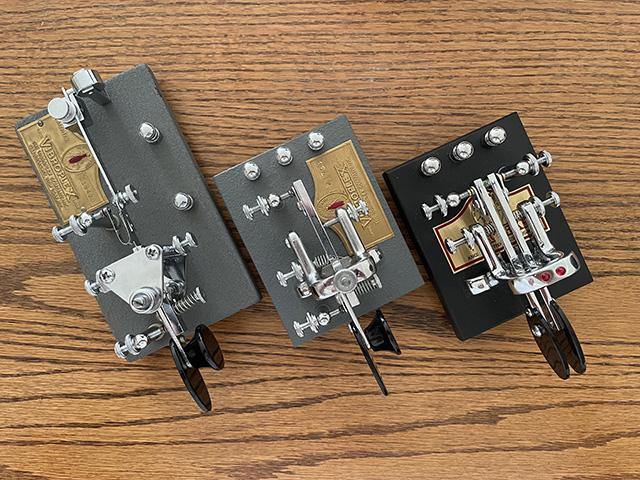
I now own four bugs and I bought them all last week. Haha! A friend tipped me off to an auction house that had what appeared to be auctioning off a Vibroplex collector’s estate. There were some rare pieces in the collection, such as the Upright and also the Midget. Other rarities like a Vibroplex Double lever and a Model X were in the mix. Had I known anything about what I was looking at, I would have at least bid on some of the more rare items. Looking back at the winning bid prices shows that some people got real collector’s items for dirt cheap. Since I did not know much at the time regarding which bugs were more rare and valuable than others, I simply looked at the ones that would look good placed next to my 1963 Vibroplex Vibrokeyer. That is to say a bug with a gray base and chrome components. I happened to bid on a lot that consisted of three such bugs–a #6 “Lightning Bug”, an Original, and a #4 “Blue Racer”. I won the lot and was happy to now be the proud owner of a Vibroplex bug, or three.
I then started doing some research. Yes, I know I did all of this in the wrong order. From what I gather, one of the most referenced guides for the Vibroplex collector is Tom French’s “The Vibroplex Collector’s Guide” from 2006 and the most referenced resource used to find out the age of a particular bug is John Elwood’s “Birthdates of The Vibroplex Keys” from 1996. There’s an easy-to-use online bug dating site (hehe) for Vibroplex bugs that uses Mr. Elwood’s list. After using this information, I learned that the three bugs I won at the auction are from the mid 1940s before the end of the Second World War. All three keys are Deluxe versions of their respective models and while all Deluxe models would typically have chromed bases, these have gray bases. More precisely, they have “battleship gray” bases, which were the result of chromium being in high demand for wartime use and so Vibroplex paused using chrome on their bug bases again until after the war ended. So, that’s a bit interesting. Shortly after winning that auction, I must have gotten big by the bug (whomp whomp) and bought another bug on QRZ’s swap meet. This time, an early 1960s Vibroplex Champion. This one was the first to arrive at my doorstep and it has been interesting to play around with and learn the nuances of using a bug successfully. Having a solid grasp of how properly sent code should sound already in my wheelhouse of Morse knowledge makes using a manual or semi-automatic key much easier, I’ve found. It is taking some time to get used to manually sending dahs, though.
I was a bit apprehensive about buying any of these at first, having never used a bug before. They always sound so noisy in Youtube videos that I’ve seen of them in use and so I’ve avoided them until now. I will say, though, that perhaps this is part of the nuance of bug operating. At first, the Champion did seem to be a bit noisy, but after researching how to properly adjust a Vibroplex bug, I was surprised that this bug is actually not that noisy when properly adjusted. Go figure.
I found it quite interesting to read about the history of The Vibroplex Company in Tom French’s guide. What baffled me most is the lack of sensible serial numbering of Vibroplex devices over the years. It seemed as though each owner of the company had just gone willy nilly in regard to which serial numbers they wanted to assign to the devices produced during their ownership. Luckily, at least for serial numbers up into the late 1990s, we have some authoritative guidance on which serial numbers were assigned to which bugs and when.
I wouldn’t call myself a Vibroplex collector now, by any definition of the term. I do think I have a bit more appreciation for the semi-automatic Vibroplex, though. Now that I’m armed with a bit more knowledge of some of the more historical pieces from Vibroplex, I’ll be keeping a keen watch for good deals on valuable keys when at hamfests and antique shops where they might turn up.
Do you use a bug? Do you prefer the semi-automatic operation of the bug over an electronically keyed set of paddles or single-lever? Got any tips for a budding bug operator? Let me know with a comment.
73,
Matthew, K2MAS
As a member of Amazon’s Associate program, I earn a small commission on qualifying purchases made through referrals. This helps offset the costs of hosting this website and are greatly appreciated.
 K2MAS.net