The weekend started with a minor geomagnetic storm which threatened to thwart any efforts on 10-meters. I checked a local ham’s SDR to see how the band looked and was surprised to see it fairly active. I guess you can’t really know if you’re going to make some contacts when solar weather is in a particular way unless you just get on the air and find out. I put my antenna up when I arrived home from work anyway to get myself ready to participate in the ARRL 10-Meter Contest nonetheless.
While I entered the contest with the expectation that I’d work from start to finish, only breaking for bio breaks, food, and sleep, I had to acknowledge that 10-meters doesn’t always fare well after sunset. I vowed to work tirelessly from sunrise to sunset on Saturday and from sunrise on Sunday until contest stop at 7pm EST.
The ARRL 10-Meter Contest allows phone and CW modes only and of course, only the 10-meter band can be used. To provide for better competitive conditions for those without contest station quality antennas, a “Limited Antenna Overlay” is available for contest entrants who use single-element antennas hefted no more than 50 feet above ground at its highest point. I would not be surprised, however, that this category will be the most crowded once contest results are released.
Day One – A lot of Florida stations this evening!
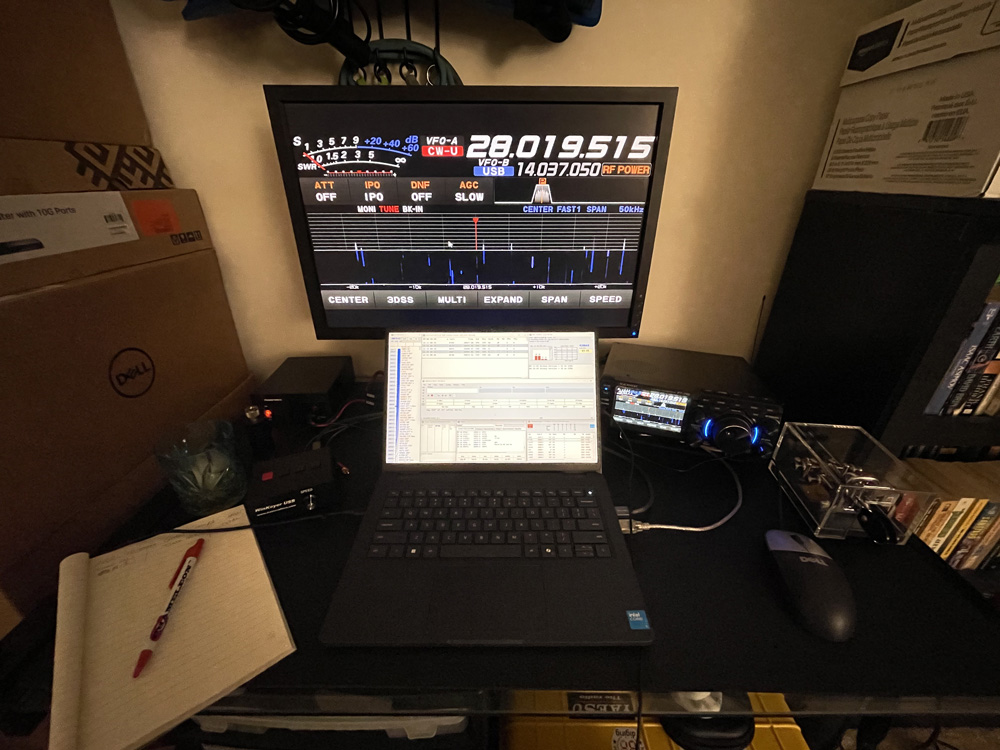
I set up N1MM+, WinKeyer USB, and my Yaesu FT-710 and got on the air a few minutes after the contest start. It took me a while to get N1MM+ to send through the WinKeyer again. I had unplugged everything from the laptop since I last used it during the CQWW DX contest and after plugging everything back in, the COM ports had changed from what they were set to previously. It took a bit to nail that down and get things working again. I made my first Q at 7:25 PM. I ended up with 14 Qs before working all the stations I could hear. By 8:30 PM, I was ready to call it a day.
Most of my contacts were from Florida. I heard a couple DX stations but they were in and out and I could not confidently copy their exchanges so I didn’t work them.
Day Two – How long can I operate without stopping?
I woke around 6:20 AM and made a cup of coffee and headed out to put the antenna back in the air. The game plan for day was to work as many stations as I could before some forecasted Winter weather set in later in the day. Given that my antenna system is a simple end-fed wire placed in the air at the end of a 33ft carbon fiber mast, I knew that any freezing rain or other inclement weather might cause some problems to my gear, possibly causing the mast to break, and I’ve already had to fix it once. I didn’t want to do it again.
There wasn’t much activity on the band so I didn’t make my first contact of the day until 7:17 AM when I reached EF5Y for my first DX contact of the contest. I was his 621st. I struggled a bit in the early hours, seemingly from some QSB and my lack of skill copying groups of numbers. It was an odd thing, that. The exchange for North American hams was supposed to be RST + State/Province. However, there were a lot of hams from the U.S. who were sending a serial number instead of their state. Serials are only part of the exchange for DX stations, so I’m unsure why these hams decided to use that exchange.
I saw a POTA spot for K4SWL on 20 meters, so I temporarily stopped contesting and went to hunt that guy. I could hear him, but 20 is noisy for me and he was about a 22N here and was fading in and out. Someday, I will get him into my logbook! But this day was not that day. Back to 10 meters and contesting I went.
I was up to 80 Qs around 12:30 PM before breaking for lunch and I stepped away to rest my back and eyes. I really need to figure out a more ergonomic operating position for the station. I’m currently using a piano bench and an old glass office desk which has all my radio gear stored underneath it. So I’m hunched over for the most part when operating the station.
While filling my face with my wife’s home cooking and imbibing a bit with my favorite whiskey, I checked in on the current solar weather conditions. At midday Saturday, we were experiencing an increase in solar wind activity from coronal hole #06, which was Earth-facing. I did a quick online search to learn more about how solar wind can affect the propagation conditions for the 10-meter band and learned that a faster, stronger solar wind has adverse effects on this band due to disturbances at the F-layer. Apparently, some common effects are QSB and loss of long distance DX. But on the flip side, apparently these same disturbances can open propagation paths that would typically not be open. I will say that I did notice some signal fading in the late morning, but am still hearing DX stations in Europe occasionally calling CQ.
After a successful lunch, I got back into the swing of things with the expectation that I would do my best to search and pounce as many stations as I could get before local weather conditions deteriorated overnight, as was being forecasted.
QSB issues were present more than before my lunch break. On a couple occasions, contacts ended up NIL because fading set in before the full exchange could take place. I had to lower my expectations of a 200+ contact contest showing to just a 100+ one, which seemed more reachable unless conditions improved as the day got older. But I pressed on, nonetheless.
It was a tough slog, though. My Qs-per-hour dropped to single digits. Keep in mind that I was entirely S&P this whole contest, but this was the first time since the start of the contest that my per-hour rate fell to single digits. At 91 Qs, I stopped for a while with the hope that later in the afternoon, there would be new stations on the air and within range of me and/or solar weather conditions would be slightly better. I had no idea if things would play out that way, but I knew I wasn’t making much headway at that moment. At this point, I was content with breaking the triple digit QSO count and then tossing in the towel.
After getting back to the radio, I managed to work a few more stations, but the band conditions were not all that hot at my QTH. I managed to work 101 total contacts with the last one being my first Mexican station worked. That was exciting for me!
I had been keeping an on-air / off-air log to keep track of how much time I was spending at the radio and by the end of the day, I had just crossed the 8-hour mark for just shy of 13 QSOs per hour average. A look at the weather forecast showed several inches of snow predicted to fall overnight and 20-30 mph winds with even higher gusts possible all day on Sunday, so no contest efforts expected from my station for the final 24 hours of the contest. That’s kind of a bummer for me, but I am proud of my performance for the period of time I was able to participate.
Call: K2MAS
Operator(s): K2MAS
Station: K2MAS

Class: SO CW Unlimited LP
Class Overlay: Limited-Ant
QTH: VA
Operating Time (hrs): 8

Summary:
 Band  QSOs  Mults
-------------------
   CW:  101    47
  SSB:
-------------------
Total:  101    47  Total Score = 18,988

Club: Potomac Valley Radio Club
73 all,
Matthew, K2MAS
 K2MAS.net