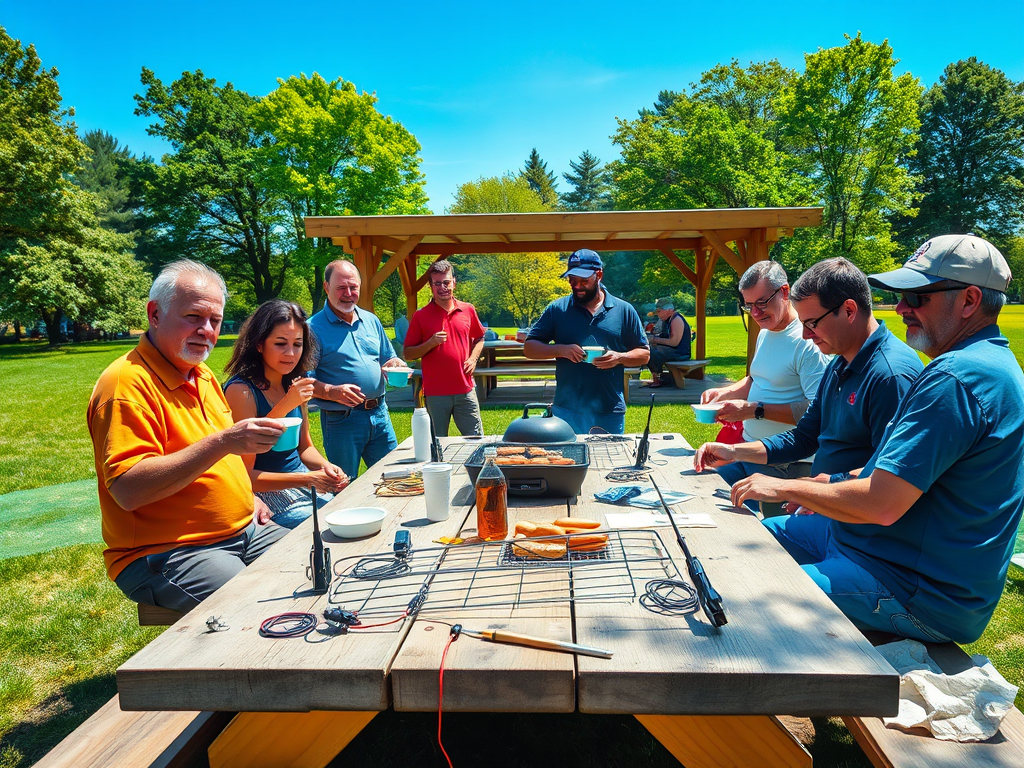
This weekend, the Vienna Wireless Society amateur radio club held its annual Fall Picnic at Nottaway Park in Vienna, VA. This year’s event featured an antenna build before the picnic, and a foxhunt afterward. The antennas we built were the infamous tape measure yagi antenna that is a fun and useful foray into learning how to build a functional antenna that can be easily connected to a simple handheld radio.
The picnic was scheduled to begin around 11:00 am, but the antenna build participants began building their antennas shortly after 9:00 am. The VWS team set up several tables and laid out all of the parts needed to build two yagi antennas on each table. The parts included several pieces of PVC pipe and fittings and a single 25-foot metal tape measure. With two hams per table, we were able to put together two yagi antennas from the provided PVC pipe and tape measure.
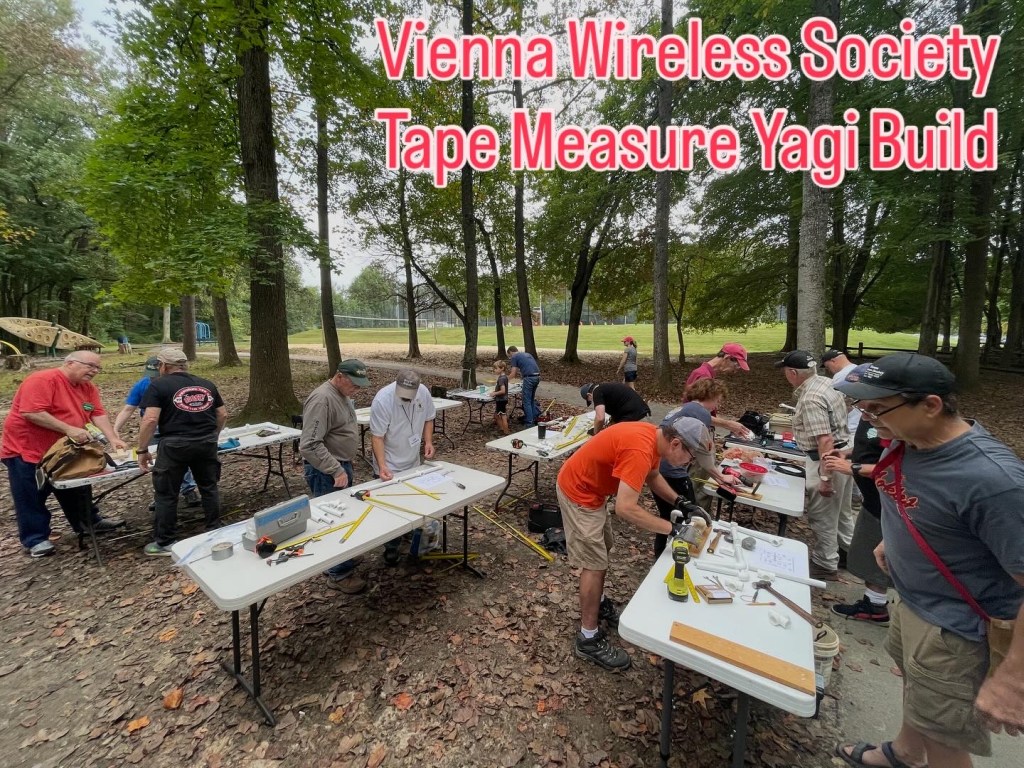
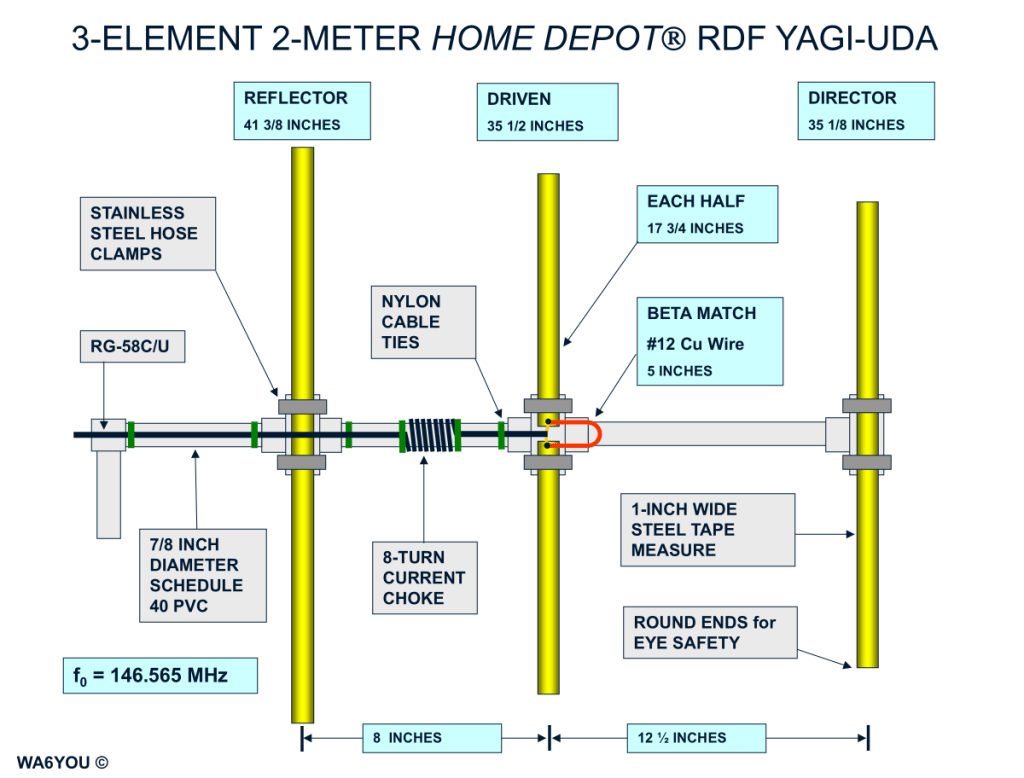
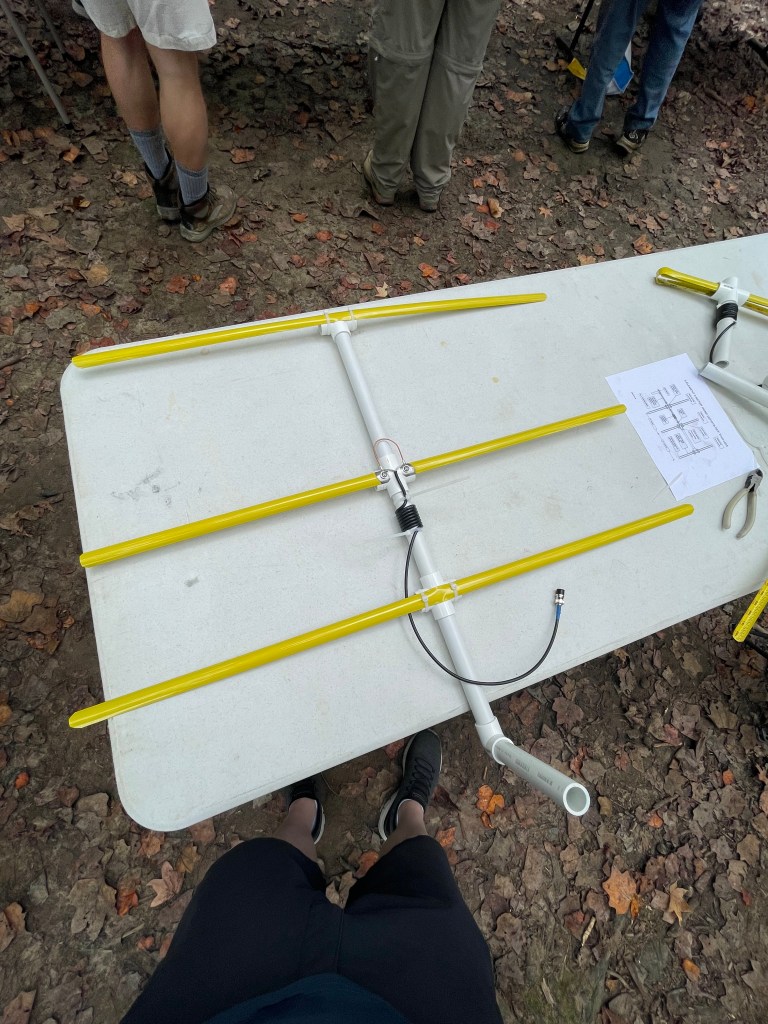
We began by cutting the radiator portion of the antenna by cutting two lengths of 18-1/8″ from the tape measure for each ham at the table. The VWS team had premade the hairpin match for us so we didn’t need to do anything for that. They also made the coax feed lines for each builder prior so that the appropriate interface between feed line and HT could be made. I opted for a BNC-M connector so that I could have more applications for the antenna than just with a Yaesu HT.
The next step was to cut lengths of 41-3/8″ and another of 35-1/8″ from the tape measure. 25 feet of metal tape measure was plenty enough to make two 3-element yagi antennas. There was several feet of tape measure left over. The longer element was to serve as the reflector and the shorter as the director. With the coax feed line, we made a balun by wrapping 8 turns of cable around the PVC just behind the driven element.
Ron, WA6YOU, provided the builders with a schematic. As you might notice, we deviated from the schematic on the length of the radiating elements. The combined 36-1/4″ driven element we made placed the resonant frequency of our antennas near 146.330 MHz or so.
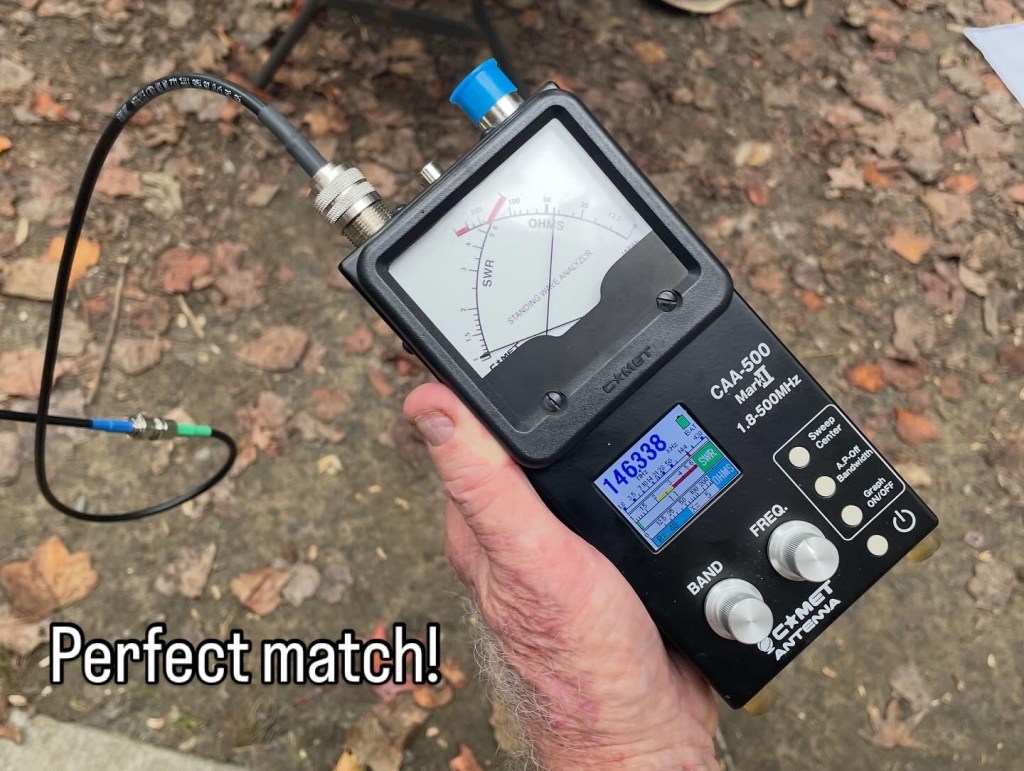
With the antennas built, we put them on the SWR meter to make sure everyone assembled their kits correctly. I was happy to discover that my antenna measured 1:1 SWR and I hoped that I’d be able to take home another VWS Fox Hunt trophy like I did back in the Spring. Sadly, I did not find either of the foxes that were hidden around the park. Congratulations to my club mates who did.
The antenna build was a lot of fun, even though I rarely, if ever, get onto the VHF/UHF bands. I do have a bit of difficulty reaching one of the club’s repeaters from my QTH, so I plan to experiment to see if I’m able to hit it with the yagi. It was also a fun exercise in direction finding using this type of antenna and this is likely to be my primary use case for this antenna, unless I pair it with my Yaesu FT-7900 sling pack kit and try to work satellites with it. While panning left or right, when you hear the signal fade, you know the signal is reaching the antenna in one of its nulls. What this means for the fox hunter is that the fox is somewhere in the direction of that null, whether it be on one side or the other.
One thing we lacked was an attenuator which would have made it a bit easier to track down the relatively strong signal from the fox’s transmitter. Since we were in such close proximity to them both, it was easy for them to max out the S-meter on our radios even with the small amount of power they were emitting. With an attenuator, you’re able to attenuate the received signal such that it no longer maxes out your S-meter. This allows you to judge location based on meter fluctuations that would be unnoticeable if the meter stayed maxed out. Perhaps I’ll find some instructions to build one for cheap and put that together for next time.
The Vienna Wireless Society (VWS) is an ARRL-affiliated Amateur Radio Club located in Vienna, Virginia, USA. It was founded in 1963. With a membership of over 300 licensed amateur radio operators and monthly technical meetings, VWS is among the largest and most active Amateur Radio clubs in Northern Virginia. The VWS program of radio-related activities and public service rests on three main pillars: (1) scientific, technological, and educational activities, (2) recreational operating activities, and (3) emergency service activities.
Learn more at ViennaWireless.net
73,
Matthew, K2MAS
K2MAS.net is not affiliated with any of the sites or products listed in this article. All opinions are the author’s own.
As a member of Amazon’s Associate program, I earn a small commission on qualifying purchases made through referrals. This helps offset the costs of hosting this website and are greatly appreciated.
 K2MAS.net