
Another week of amateur radio has expired. Expired Ham, get it? 🙂
Welcome to another issue of Expired Ham, a weekly newsletter where I discuss the ways I participated in the amateur radio hobby this week.
No luck with getting out with my KX3 kit this week. As I’m sure most hams are well aware, this week brought us a nice coronal mass ejection from our friend, Sol. Band conditions were certainly affected by that for a while this week. The solar weather cleared up just in time for our local weather to get worse. By the weekend, I was kept indoors by rain and thunderstorms. How I wish I lived somewhere that allowed permanent outdoor antennas.
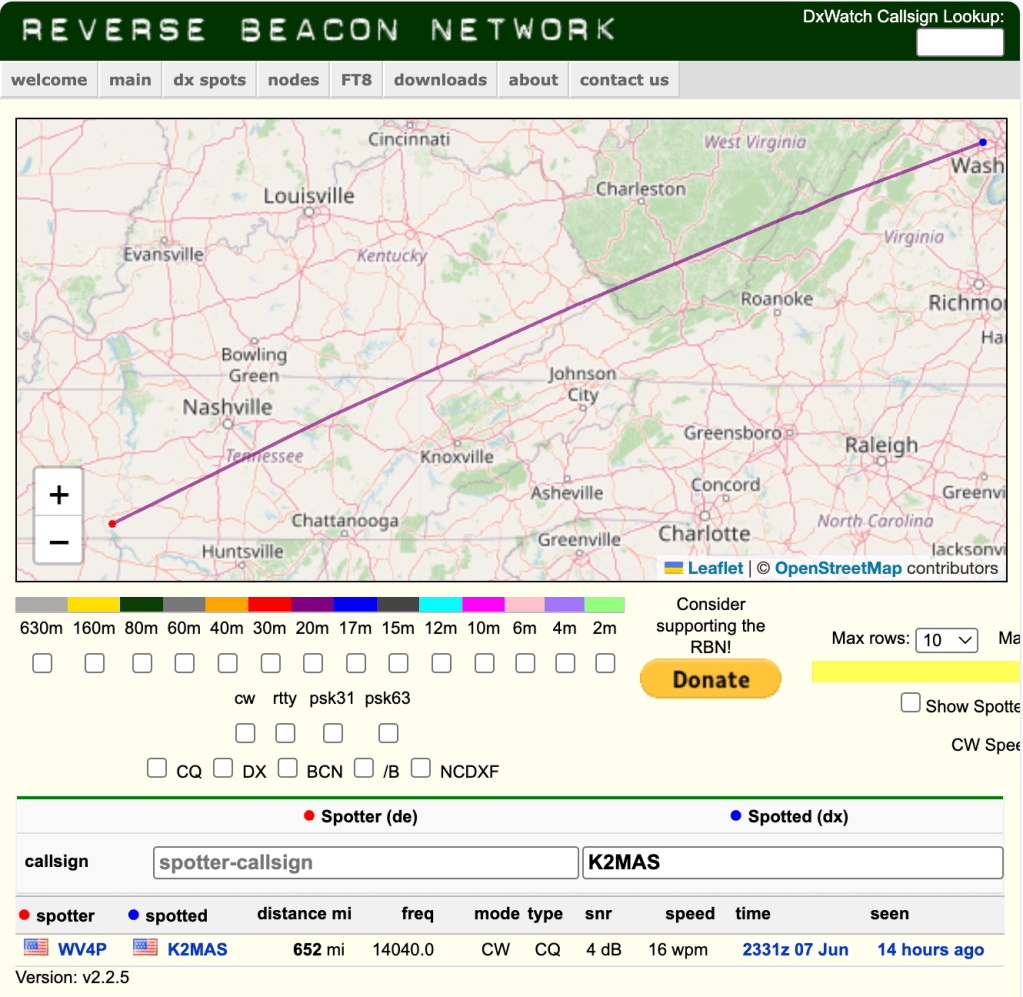
I did play around a bit with the KX3 late this week. I connected my Chameleon CHA-FLOOP-3magnetic loop antenna to the radio and called CQ for a bit. I wasn’t expecting to be heard or called back, but was curious whether the reverse beacon network would pick up my signal. I wondered what signal report I would see if I was heard at all and from where. Sure enough, I managed to get spotted and surprisingly with a much higher SNR than I was expecting and from further away also. WV4P spotted my CW CQ 652 miles away in west Tennessee and gave an SNR of 4 dB! I was calling CQ with just 6 Watts radiating from a compromised indoor antenna, so this report was almost unbelievable. Then I looked up WV4P’s QRZ page and saw a photo of their antenna tower and it all made sense. Either way, though, I’m excited to know that my CW signals can actually leave the confines of my house.
I purchased a mono earphone to attach to my Yaesu FT3DR HT this week so that I could listen in on some of the conversations on some of the Fusion rooms I connect to without disturbing my better half. It turns out that the audio level through the earphone is so high that I worry about damaging my hearing. When connected, I can only turn the volume up one level higher than muted before it becomes uncomfortably loud. If you know what I might be able to do to resolve this, please leave me a comment below. I’d love to figure it out.
Spring is almost over so I’m trying to fit in some last minute Spring cleaning chores related to my amateur radio gear. I have been making efforts to consolidate items into “go-bags” or “grab-n-go” boxes that can contain everything needed to play radio outdoors. So far, I have kits assembled for my Yaesu FT-710, Elecraft KX3, and QRP Labs QMX radios. My Yaesu FT-891 doesn’t have a home, but to be honest, it can be swapped in or out for the FT-710 depending on which radio I feel like using.
In an effort to augment my CW education through CWOps’s CW Academy, I joined the Long Island CW Club as lifetime member #8169. While I really enjoy the CW Academy training course, much of the students’ learning is dependent on their ability to teach themselves. Meeting with a CWA advisor twice a week provides feedback on progress and advice on how to overcome obstacles encountered between advisory sessions. It’s a good program and I’m feeling better skilled than I was before class started, for sure. However, the curriculum delivery from the LICW program is much different in that they offer live classes daily to their membership. My expectation is that I’ll be able to continue through the remainder of the CWA Fundamental course while also attending a few of the LICW classes as time goes on.
I also came across some fun learning tools for CW that I feel like sharing with anyone interested. First, there is the notion of making learning to send and receive Morse code fun by gamification. We have access to two tools from Ham Radio Duo called Morse Code Battleship and an AI-based learning tool called Virtual CW AI CW-Bot. Another fun tool is Morse Invaders which is a game similar to the old Space Invaders game for Atari which puts your CW sending skills to the test to protect your city. I like this one because it forces you to properly space your characters otherwise your city is obliterated.
Other notable CW-related online tools include Morse Walker which I take to be a play on the popular Morse Runner contesting practice tool which is unfortunately not available natively for us macOS users. While maybe not as fully-featured as Morse Runner, Morse Walker provides excellent practice for popular contesting such as POTA activating, CWOps CWT operating, and the K1USN SST. And then there is Vail, which is an online “CW repeater”, which allows you to have online QSOs with other site visitors. I’m unsure how active the site is as I’ve not heard anyone calling CQ yet and nobody has answered when I’ve called CQ over the last couple of days. It’s worth checking out. The more people using it, the merrier. And lastly, there is the CW QSO Finder. This is another site that doesn’t seem to be heavily in use, but it is in use as I’ve seen a number of ops share that they are available for on-air QSOs. This site is different than the others in that the QSOs take place through your radio and not over the internet, which could be useful if you’re ready to make an on-air contact.
Alright, I need to get back to my Spring cleaning chores now. 73 to you all.
Matthew, K2MAS
K2MAS.net is not affiliated with any of the sites or products listed in this article. All opinions are the author’s own.
As a member of Amazon’s Associate program, I earn a small commission on qualifying purchases made through referrals. This helps offset the costs of hosting this website and are greatly appreciated.
 K2MAS.net